

Cyber defense starts with situational awareness. You need a current view of your environment, the adversaries moving against it, and the activity that matters to you. Without it, every decision is a guess.
That view is harder than ever to assemble. Advisories, newsletters, social posts, and government alerts arrive faster than any team can read them. But the deeper problem isn't volume. It's coherence. Indicators, actors, vulnerabilities, products, and motivations live in different systems, on different timelines, with no consistent thread tying them to your organization.
What situational awareness actually requires
Useful situational awareness does three things at once: knowing what is happening across the threat landscape, understanding why and how the pieces connect, and assessing what it means for your organization. Most security teams have feeds and dashboards for the first. The second and third are where the work piles up, and where breaches start.
Enter: Mallory Stories
A Mallory Story is a cluster of references: articles, advisories, posts, reports, and indicators, bound together because they describe the same underlying situation. One Story per situation, no matter how many sources are talking about it.
Each incoming reference is processed by a team of intelligent analyst agents that extract entities, indicators, actors, vulnerabilities, products, motivations, and timeline events, and emit structured metadata about it. That metadata is assessed against the existing Story corpus. A qualifying reference either matches an existing Story, joining that cluster and updating it (including the timeline) with any new content it carries, or it seeds a new protostory that can grow into a full Story as more references arrive.
The Timeline
Every Story has a timeline, and the timeline is where situational awareness lives. Agents extract dated events (initial disclosure, first observed exploitation, vendor advisory, patch release, public PoC, victim disclosures, government guidance, follow-on campaigns) and place them on a single ordered view that updates in near real time.
The backstory matters as much as the current state. Adversary campaigns rarely start the day you hear about them. Vulnerabilities have lifecycles that begin weeks or months earlier. A timeline that captures the full backstory turns a current event into a situation you actually understand. Without it, every Story is a single frame. With it, you have the whole film, and you can see where the next frame is likely to land.
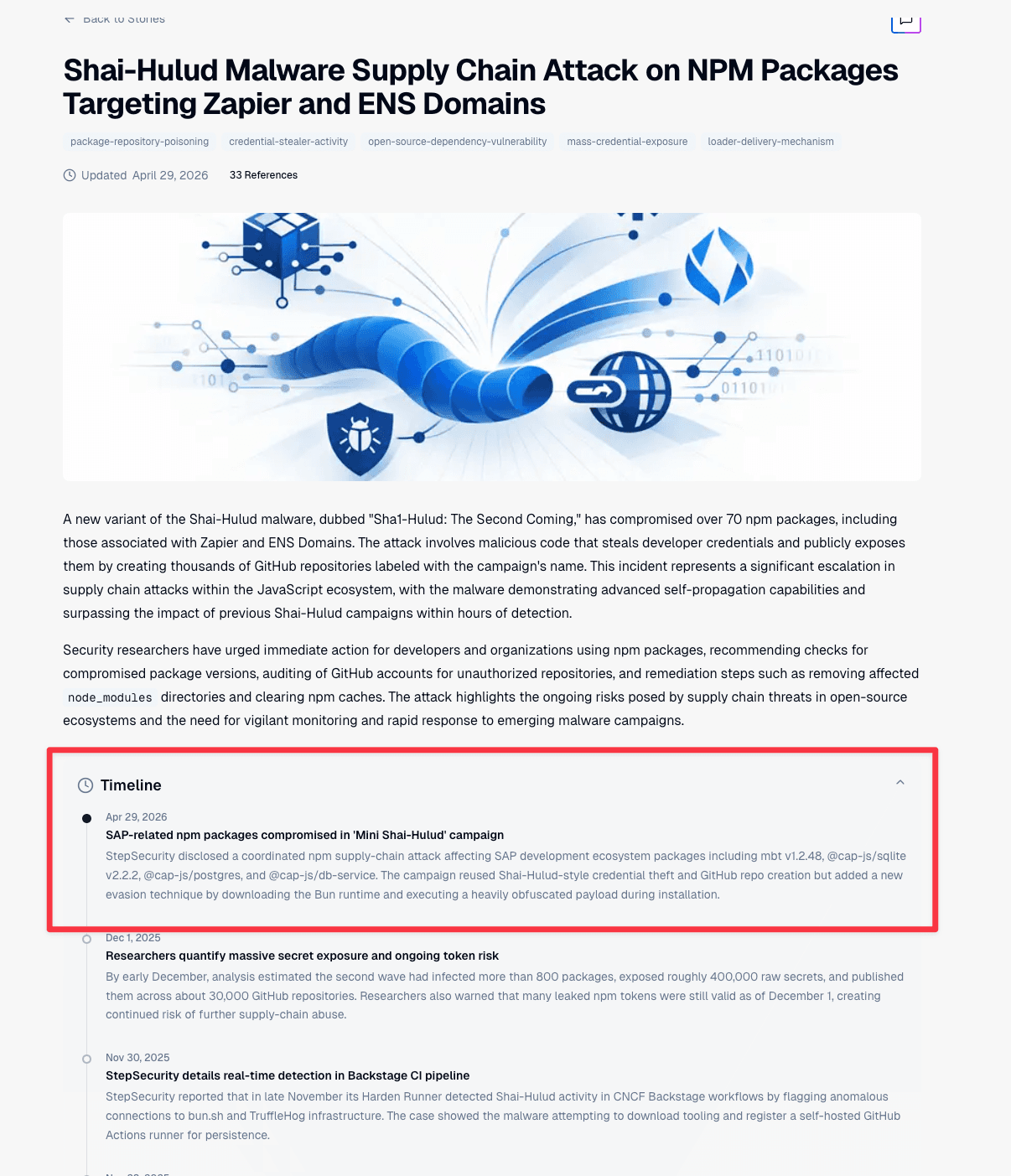
Through Mallory's interfaces you can ask natural-language questions to tailor any Story to your environment, your stack, and your risk profile. And, most importantly, get suggested actions specific to your organization.
For more information visit mallory.ai, and for a free feed of emerging news stories visit news.mallory.ai. A quick interactive walkthrough of Stories is below.
Try Mallory for Free
Get cyber situational awareness with Mallory Stories. Real-time threat intelligence tailored to your environment.
Get Started for Free