
Malicious and Credential-Stealing npm Packages Target Developers via Obfuscation and Typosquatting
Multiple malicious npm packages have been discovered targeting developers by employing advanced obfuscation techniques and typosquatting to mimic popular legitimate packages such as TypeScript, discord.js, ethers.js, nodemon, and Claude Code. Security researchers revealed that these packages use up to four layers of obfuscation—including eval wrapping, XOR encryption, URL encoding, and control flow manipulation—to evade static analysis and conceal credential-stealing malware. The attack chain often begins with deceptive tactics, such as displaying fake CAPTCHAs, and proceeds to exfiltrate sensitive information like IP addresses and credentials to attacker-controlled servers. In one notable case, a package impersonating the official Anthropic CLI was found to proxy commands and data back to the threat actor, enabling both credential theft and remote command execution.
These incidents highlight the persistent risks posed by weak validation and oversight in the npm ecosystem, allowing threat actors to publish lookalike packages that are difficult to distinguish from legitimate ones. The sophisticated payloads not only target local developer environments but can also compromise CI/CD pipelines, amplifying the potential impact. Security experts emphasize the need for improved package metadata validation and greater vigilance among developers to mitigate the risk of supply chain attacks through open-source dependencies.
Get ahead of threats like this
Mallory correlates global threat intelligence with your attack surface — know if you’re exposed before adversaries strike.
How this story unfolded
3 events from the most recent confirmed update back to the earliest known activity.
Security guidance is published on practical npm supply-chain defenses
A follow-up security discussion highlighted practical steps for staying safe on npm, reflecting industry response to ongoing malicious-package threats. This was guidance and awareness activity rather than a new attack event.
Researchers reveal credential-stealing npm packages using four obfuscation layers
Analysis published days later described npm packages that stole credentials while hiding their behavior behind four layers of obfuscation. The reporting indicates a broader malicious package campaign or additional technical detail beyond the initial discovery.
Malicious npm package impersonating Claude Code is discovered
Researchers identified a malicious npm package masquerading as Anthropic's Claude Code tool. The package was designed to deceive developers into installing a trojanized dependency under the guise of a legitimate AI coding utility.
Related entities
Vulnerabilities, threat actors, malware, products, organizations, and breaches Mallory has linked to this story.
Sources
3 references tracked. Mallory keeps watching after this page renders.
The Changelog Podcast: Practical Steps to Stay Safe on npm
socket.dev
Open sourceCredential-stealing npm packages hide beneath 4 layers of obfuscation
scworld.com
Open sourceMalicious NPM package pretends to be Claude Code
getsafety.com
Open sourceSee the full picture, correlated to your attack surface.
Map indicators from this story to your assets and identify affected systems in minutes.
Every observed campaign, victim, and pivot linked to actors named in this story.
Malware, exploits, and IOCs connected to the activity described here.
YARA, Sigma, and Snort rules deployed to your SIEM as soon as they’re published.
Get matching new stories delivered to your team as they break — not the next morning.
Ask questions about this story and take action on the answers.
Related stories
Other stories Mallory is tracking that overlap on entities, sources, or topic labels.

Malicious npm Packages Stealing Developer Credentials Across Platforms
Security researchers have uncovered multiple campaigns involving malicious npm packages designed to steal developer credentials and sensitive information from Windows, macOS, and Linux systems. In one operation, ten typosquatted packages impersonated popular libraries such as TypeScript, discord.js, ethers.js, and others, using sophisticated obfuscation, fake CAPTCHA prompts, and postinstall hooks to deploy an information stealer that harvested credentials from system keyrings, browsers, and authentication services. The malware executed in a new terminal window to evade detection and sent stolen data, including IP addresses, to external servers. Another large-scale campaign, dubbed 'PhantomRaven,' involved 126 npm packages and over 86,000 downloads, targeting authentication tokens, CI/CD secrets, and GitHub credentials. These packages leveraged remote dynamic dependencies to fetch and execute payloads during installation, profiling infected devices and exfiltrating secrets for potential supply chain attacks. The attackers employed techniques such as slopsquatting, where AI-generated package recommendations led developers to install non-existent, malicious packages. Some packages impersonated tools from GitLab and Apache, and many remained available on npm at the time of reporting. The campaigns highlight the ongoing risks in the npm ecosystem, with attackers exploiting both user trust and platform weaknesses to compromise developer environments and CI/CD pipelines. Security experts warn that the theft of tokens and credentials could enable further attacks, including the introduction of malicious code into legitimate projects and broader supply chain compromises.
Mar 21, 2026
Malicious npm Packages Distribute PyInstaller Infostealer via Typosquatting and Fake CAPTCHA
Ten malicious packages were discovered on the npm registry, masquerading as popular JavaScript libraries through typosquatting techniques. These packages, which included names like `typescriptjs`, `deezcord.js`, and `react-router-dom.js`, were designed to trick developers into downloading them by mimicking legitimate projects. Upon installation, a postinstall script executed a heavily obfuscated loader that displayed a fake CAPTCHA in the terminal to appear legitimate, then downloaded and ran a 24MB infostealer built with PyInstaller. This malware targeted Windows, Linux, and macOS systems, stealing credentials from system keyrings, browsers, and authentication services. The campaign went undetected for an extended period, resulting in nearly 10,000 downloads before being reported to npm, with the malicious packages still available at the time of reporting. The infostealer's deployment leveraged multiple layers of obfuscation, including self-decoding wrappers, XOR decryption, and control-flow obfuscation, to evade static analysis and detection. The attack highlights the ongoing risks posed by supply chain threats in open-source ecosystems, particularly through typosquatting and social engineering tactics. Security researchers emphasized the importance of vigilance when installing npm packages and recommended enhanced scrutiny of package names and sources to mitigate the risk of inadvertently installing malicious software.
Mar 21, 2026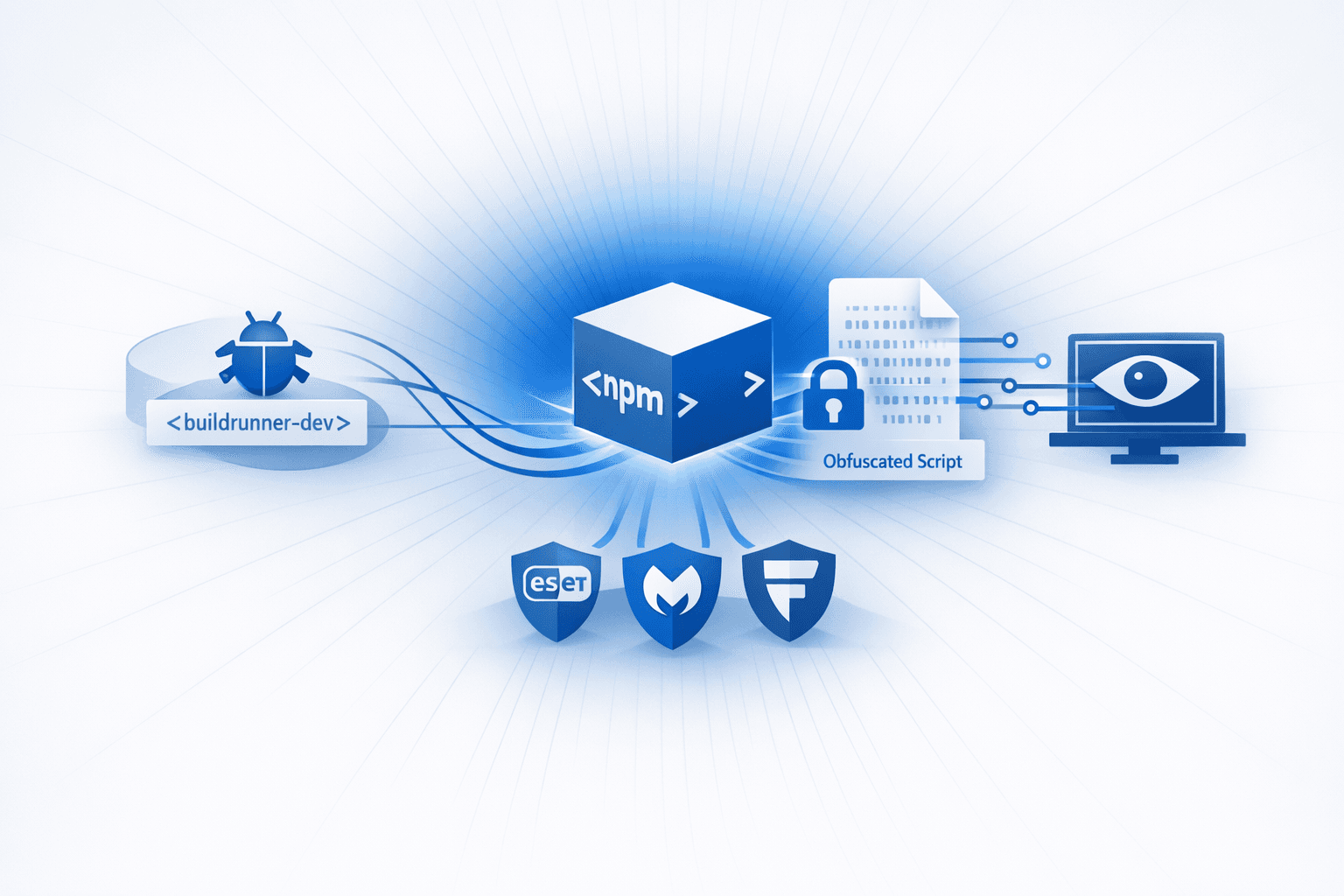
Malicious npm Packages Using Typosquatting and Payload Obfuscation
Threat researchers reported an **npm supply-chain attack** in which a typosquatted package (`buildrunner-dev`) delivered **Pulsar RAT** via a multi-stage Windows infection chain. The package executed a script that fetched a large, heavily obfuscated batch file (`packageloader.bat`) containing mostly “noise” to evade static detection, performed security-product checks (including **ESET**, **Malwarebytes**, and **F-Secure**), established persistence by copying itself as `protect.bat` into a hidden folder, and attempted privilege escalation/UAC bypass using `fodhelper.exe`. Separate supply-chain reporting highlighted how package-name deception is evolving beyond human typos into **“slopsquatting”** (AI/hallucination squatting), where attackers register package names that LLMs commonly invent and then rely on developers installing them on AI recommendation. Documented tradecraft includes malicious `postinstall` scripts to exfiltrate secrets from developer environments (API keys, cloud tokens, npm auth tokens) and the use of URL-based dependencies to fetch external payloads at install time, allowing the published package to appear benign to naive scanners.
Mar 21, 2026