
AI-Enabled Cybercrime and Deepfake-Driven Social Engineering at Scale
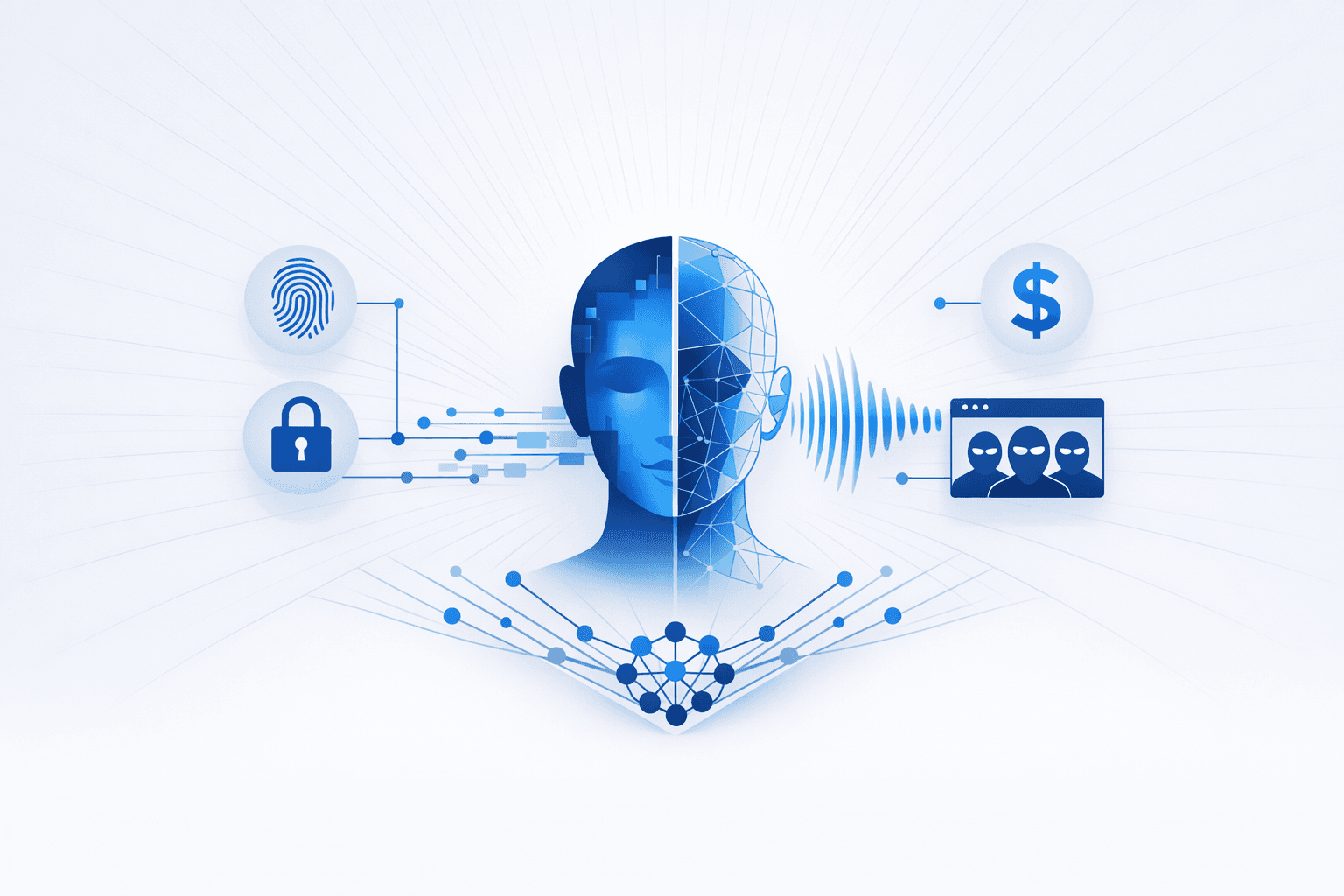
Threat intelligence reporting warns that generative AI is accelerating the industrialization of cybercrime, lowering cost and skill barriers while increasing speed and scale. Group-IB described a “fifth wave” in which criminals weaponize AI to produce synthetic identity kits—including deepfake video actors and cloned voices—for as little as $5, enabling fraud and bypass of authentication controls. The report also cited a sharp rise in dark web discussion of AI-enabled criminal tooling (from under ~50,000 messages annually pre-2022 to ~300,000 per year since 2023) and highlighted the shift toward “agentic” phishing kits that automate targeting, lure creation, and campaign adaptation via low-cost subscriptions.
Industry commentary and forward-looking security coverage similarly anticipate AI-enabled social engineering becoming a dominant enterprise risk, with deepfakes eroding trust in audio/video channels and enabling more convincing phishing at scale across languages and cultures. Separately, business-leadership coverage frames cybersecurity and AI as intertwined with geopolitical risk and board-level decision-making, but provides limited incident- or threat-specific detail. An opinion piece argues AI will reshape the security vendor landscape and drive consolidation, but it is not focused on a specific threat campaign or disclosure.
Get ahead of threats like this
Mallory correlates global threat intelligence with your attack surface — know if you’re exposed before adversaries strike.
How this story unfolded
3 events from the most recent confirmed update back to the earliest known activity.
Group-IB says generative AI is driving a fifth wave of cybercrime
Group-IB assessed that generative AI is fueling a 'fifth wave' of industrialized cybercrime by making advanced attack capabilities cheaper, faster, and more scalable. The report highlighted synthetic identity kits, agentic AI phishing, and broader automation of fraud and intrusion activity.
Criminals shift from public chatbots to self-hosted dark LLMs
According to Group-IB, cybercriminals moved from abusing public chatbots to developing and marketing proprietary self-hosted 'dark LLMs,' including tools such as Nytheon AI for malware creation and scams. This marked a more mature and purpose-built use of AI in cybercrime operations.
Dark web discussion of AI-enabled criminal tools surges
Group-IB reported that dark web discussion of AI-enabled criminal tooling rose from fewer than 50,000 messages annually before 2022 to roughly 300,000 messages per year starting in 2023, indicating a major increase in criminal interest and activity around AI-assisted attacks.
Sources
2 references tracked. Mallory keeps watching after this page renders.
See the full picture, correlated to your attack surface.
Map indicators from this story to your assets and identify affected systems in minutes.
Every observed campaign, victim, and pivot linked to actors named in this story.
Malware, exploits, and IOCs connected to the activity described here.
YARA, Sigma, and Snort rules deployed to your SIEM as soon as they’re published.
Get matching new stories delivered to your team as they break — not the next morning.
Ask questions about this story and take action on the answers.
Related stories
Other stories Mallory is tracking that overlap on entities, sources, or topic labels.

Widespread Use of AI and Deepfakes in Social Engineering and Cyber Attacks
A recent Gartner survey revealed that 62% of organizations have experienced deepfake attacks within the past year, highlighting the rapid adoption of AI-driven social engineering tactics. These attacks often involve the use of deepfake technology to impersonate executives, tricking employees into transferring funds or divulging sensitive information. Akif Khan of Gartner emphasized that social engineering remains a reliable attack vector, and the introduction of deepfakes makes it even more challenging for employees to detect fraudulent activity. Automated defenses alone are insufficient, as employees are now the frontline defense against these sophisticated impersonation attempts. The survey also found that 32% of organizations faced attacks targeting AI applications, particularly through prompt injection and manipulation of large language models (LLMs). Such adversarial prompting can cause AI chatbots and assistants to generate biased or malicious outputs, further expanding the threat landscape. Flashpoint analysts corroborate these findings, reporting that threat actors are actively discussing and deploying AI-powered tools in underground communities. These include specialized malicious AI models and AI-generated attack plans, which are being used to automate and scale cybercriminal operations. The most immediate threat identified is the use of AI to exploit human psychology, with attackers leveraging AI to create convincing phishing lures and fabricated realities that undermine traditional authentication methods based on voice and visual cues. Financial institutions are particularly vulnerable, as demonstrated by recent incidents where finance workers were deceived by AI-generated content. The rise of 'Dark GPTs' and Attack-as-a-Service (AaaS) offerings on the dark web further illustrates the commercialization and accessibility of AI-driven cybercrime. Security experts recommend a defense-in-depth approach, combining robust technical controls with targeted measures for emerging AI risks. AI-powered security awareness training is increasingly seen as essential, empowering employees to recognize and resist sophisticated social engineering attacks. Over 70,000 organizations are already leveraging such platforms to strengthen their human firewall. As generative AI adoption accelerates, organizations must remain vigilant against both direct deepfake attacks and indirect threats to AI application infrastructure. The evolving threat landscape demands continuous adaptation of security strategies to address the growing use of AI in cybercrime. Proactive threat intelligence and employee education are critical components in mitigating these risks. Organizations are urged to avoid isolated investments and instead implement comprehensive controls tailored to each new category of AI-driven threat. The convergence of deepfake technology, AI-powered phishing, and prompt-based attacks marks a significant escalation in the sophistication and scale of cyber threats facing enterprises today.
Mar 21, 2026
AI-Enabled Social Engineering and Scams Using Deepfakes and Automation
AI is accelerating and scaling social engineering by automating reconnaissance, targeting, and victim engagement, reducing both the cost and skill required to run convincing phishing and fraud campaigns. One reported evolution is the use of **AI agents** to collect open-source intelligence and conduct live, interactive conversations with targets with minimal or no human involvement, enabling high-volume, continuously running scam operations that can adapt in real time. Deepfake-enabled impersonation is further eroding trust in voice and video communications, including calls and meetings, with examples cited of finance staff being deceived into transferring **millions** after interacting with fabricated “executives.” Recommended mitigations emphasize shifting from human-sense validation to process-based controls—e.g., enforced verification procedures, out-of-band checks, shared authentication phrases (“safe words”), and emerging *content provenance* approaches—because traditional, predictable detection models are increasingly strained by the speed, personalization, and adaptability of AI-driven attacks.
Mar 21, 2026
AI Adoption and Misuse Expands Enterprise and Cybercrime Risk
No single incident ties the reporting together; the dominant theme is **AI’s expanding role in both enterprise operations and criminal tradecraft**, alongside broader, non-AI security trend commentary. A Docker-sponsored survey reported by *Help Net Security* says **60% of organizations run AI agents in production**, but **security/compliance is the top scaling barrier (40%)**, with recurring concerns including *prompt injection*, *tool poisoning*, runtime isolation/sandboxing, auditability, and credential/access control in distributed agent systems. Separately, forum-traffic research summarized by *Help Net Security* found cybercriminals increasingly using mainstream and local AI models to support phishing, code generation, and social engineering, with frequent discussion of jailbreaking and the use of stolen/resold premium AI accounts. Several other items are adjacent but not about the same specific story: an ESET article provides **generic guidance** on detecting **AI voice deepfakes** used for fraud; an Ars Technica piece covers **copyright/data memorization** risks in LLMs; and multiple outlets publish broader security trend or opinion content (quantum preparedness, ransomware targeting manufacturing, Romanian warnings about ransomware aligning with Russian hybrid aims, ATM jackpotting increases, and a Check Point retrospective). Some entries are primarily **commentary, historical analogy, newsletters, or how-to recon guidance** rather than new threat reporting, and should be treated as lower-signal for executive situational awareness unless your organization is actively deploying agentic AI or tracking AI-enabled fraud/social engineering.
Mar 21, 2026