
Starkiller Adversary-in-the-Middle Phishing Suite Bypasses MFA via Reverse Proxy
Researchers disclosed Starkiller, a phishing-as-a-service suite advertised by a group calling itself Jinkusu that uses an adversary-in-the-middle (AiTM) reverse proxy to bypass multi-factor authentication by relaying victims to live legitimate login pages while capturing credentials and session tokens for account takeover. The tooling reportedly runs a headless Chrome instance inside a Docker container to load the real target site and proxy traffic end-to-end, reducing the need for static phishing templates and making fingerprinting/blocklisting harder; it also provides an operator dashboard to select brands/URLs to impersonate, supports lure keyword customization (e.g., “login,” “verify,” “security,” “account”), and integrates URL shorteners (e.g., TinyURL) to mask destinations.
Separate reporting described a targeted AiTM intrusion attempt that used multiple redirect hops and an ASP.NET Core reverse proxy in front of Microsoft 365 login pages, but the author could not attribute it to any known commercial kit based on published AiTM “cheat sheets,” highlighting ongoing evolution and diversification of reverse-proxy phishing stacks beyond commonly documented PHP/Node/Go/Python implementations. Other items in the set cover unrelated malware and threat activity (Android trojans, an Iraq-focused APT campaign, an APT42 PowerShell backdoor, malvertising redirect mechanics, and scam-infrastructure/supply-chain activity) and do not materially add to the Starkiller AiTM disclosure.

Get ahead of threats like this
Mallory correlates global threat intelligence with your attack surface — know if you’re exposed before adversaries strike.
How this story unfolded
7 events from the most recent confirmed update back to the earliest known activity.
BlueVoyant describes multi-phase phishing targeting U.S. financial sector
BlueVoyant detailed phishing campaigns against U.S. banks and credit unions using spoofed .co.com domains, fake Cloudflare CAPTCHA lures, Base64-encoded redirects, and layered evasion. The activity showed a multi-phase approach designed to hinder scanners and analyst review.
Researchers detail OAuth device-code phishing against Microsoft 365
A report described a Microsoft 365 compromise technique that abuses the OAuth 2.0 device authorization grant flow. Victims are tricked into entering attacker-supplied device codes at microsoft.com/devicelogin, causing OAuth tokens to be issued to the attacker's application.
Datadog reports 1Phish evolved into multi-stage 1Password framework
Datadog reported that the 1Phish kit had evolved into a multi-stage phishing framework targeting 1Password users. The updated framework added fingerprinting and validation, OTP and recovery-code capture, and bot-filtering capabilities.
Researchers disclose Starkiller AiTM phishing suite
Researchers revealed a phishing suite called Starkiller, marketed by a group calling itself Jinkusu, that uses a reverse-proxy AiTM design to present live login pages and steal credentials and session tokens for MFA bypass. The kit runs headless Chrome in Docker, supports brand impersonation from real URLs, and uses URL shorteners and centralized dashboards to scale phishing operations.
OSINT Team reports attribution remains inconclusive for AiTM kit
The OSINT Team case study found some URL and endpoint similarities to EvilGinx, but the backend stack and other indicators did not match any single known kit. The author concluded the tooling was either an undocumented evolution of a known kit or bespoke infrastructure, with insufficient evidence for firm attribution.
Observed AiTM campaign uses fake Defender lure and ASP.NET Core proxy
An analyzed phishing operation used a fake Microsoft Defender 'Quarantine Report' lure, multiple redirect hops, and an ASP.NET Core reverse proxy of the Microsoft 365 login flow. The campaign also employed two-layer bot detection with client-side interaction checks and server-side fingerprint validation.
Sekoia documents 11 AiTM phishing kits in global analysis
In June 2025, Sekoia published a global analysis of adversary-in-the-middle phishing threats covering 11 documented phishing-as-a-service kits. This report later served as a baseline for comparing newer AiTM campaigns and tooling.
Related entities
Vulnerabilities, threat actors, malware, products, organizations, and breaches Mallory has linked to this story.
Sources
2 references tracked. Mallory keeps watching after this page renders.
See the full picture, correlated to your attack surface.
Map indicators from this story to your assets and identify affected systems in minutes.
Every observed campaign, victim, and pivot linked to actors named in this story.
Malware, exploits, and IOCs connected to the activity described here.
YARA, Sigma, and Snort rules deployed to your SIEM as soon as they’re published.
Get matching new stories delivered to your team as they break — not the next morning.
Ask questions about this story and take action on the answers.
Related stories
Other stories Mallory is tracking that overlap on entities, sources, or topic labels.
Starkiller Phishing-as-a-Service Uses Live Proxying to Capture Credentials and MFA Codes
Security researchers reported a new **phishing-as-a-service (PhaaS)** platform, **Starkiller**, that defeats many common anti-phishing controls by *live-proxying* victims to the legitimate login pages of targeted brands while relaying traffic through attacker infrastructure. Instead of serving a static fake page, Starkiller dynamically loads the real site and captures what the user enters—**username, password, and multi-factor authentication (MFA) codes**—then forwards those inputs to the legitimate service and returns responses to the victim, enabling real-time session takeover. Reporting based on **Abnormal AI**’s analysis describes Starkiller as a polished, SaaS-like offering with a dashboard, campaign analytics, and regular updates, lowering the technical barrier for running advanced adversary-in-the-middle phishing. The service supports brand selection (e.g., **Microsoft, Google, Apple, Facebook**) and uses deceptive link techniques such as embedding a trusted-looking domain before an `@` (e.g., `login.microsoft.com@...`)—where the portion before `@` is treated as username data and the actual destination is what follows—often combined with URL shorteners to increase click-through and evade user scrutiny.
Jun 29, 2026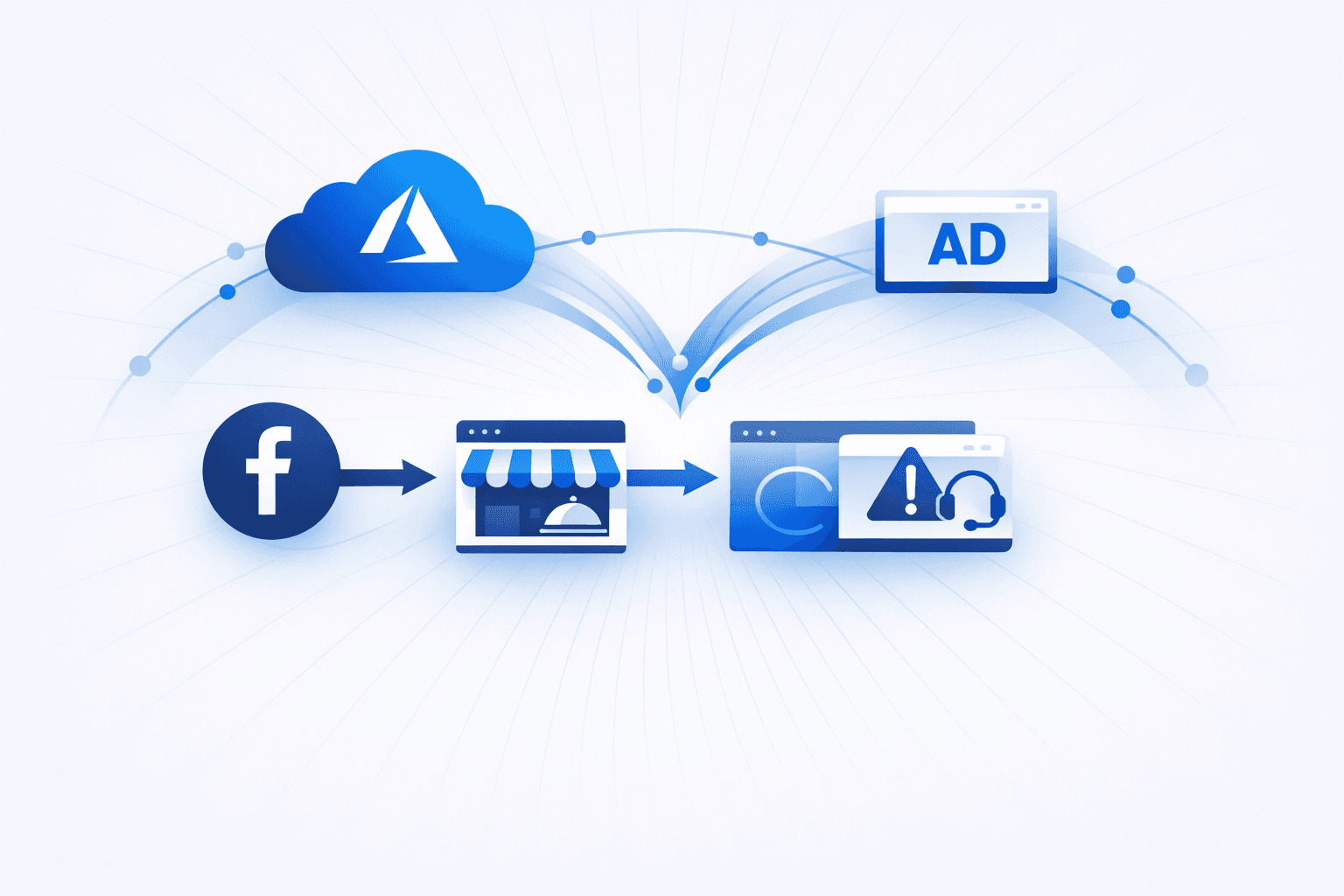
Threat Actors Abuse Trusted Cloud and Ad Platforms for Multi-Stage Phishing and Scam Delivery
Threat actors are increasingly using **trusted platforms**—including cloud hosting and major ad networks—to deliver multi-stage phishing and scam campaigns that evade traditional URL and domain reputation controls. Recent activity includes a **three-step malvertising chain** delivered via **Facebook paid ads** that redirects victims through a decoy site (e.g., a fake Italian restaurant page) before landing on a **tech support scam (TSS) kit** hosted on **Microsoft Azure** infrastructure (including `web.core.windows.net`). Researchers reported rapid infrastructure churn, with **100+ domains rotated in seven days**, and targeting focused on **U.S. users** with activity concentrated on weekdays. Parallel enterprise-focused campaigns are hosting phishing infrastructure on **Microsoft Azure Blob Storage**, **Google Firebase**, and **AWS CloudFront**, using **redirect chains, CAPTCHA gates, and QR codes** to bypass automated analysis and email defenses. Analysis highlighted the use of **Adversary-in-the-Middle (AiTM)** phishing-as-a-service kits—**Tycoon2FA**, **Sneaky2FA**, and **EvilProxy**—to steal credentials and **session tokens** even when MFA is enabled. Separately, researchers documented a “clean email” approach to steal **Dropbox** credentials: benign-looking procurement-themed emails deliver **PDF attachments** that hide clickable elements (e.g., via *AcroForms* and `FlateDecode`), which then route victims to a second-stage file hosted on **Vercel Blob** and ultimately to a fake Dropbox login page that captures credentials and collects victim telemetry (IP address, location, and device details).
Jun 29, 2026
Adversary-in-the-Middle Phishing and Evasion Techniques That Bypass MFA
Adversary-in-the-middle (**AiTM**) phishing continues to undermine traditional MFA by proxying legitimate Microsoft sign-in flows in real time, allowing attackers to capture not only passwords but also **session tokens** and MFA responses. One investigation described how sophisticated redirect infrastructure (e.g., unusually deep redirect chains) can place the final phishing content beyond the reach of many email security scanners, and how **one-time URL tokens** can prevent defenders from reproducing the full chain after the fact—making *in-the-moment* evidence collection critical. The same analysis emphasized that **phishing-resistant MFA** (e.g., **FIDO2/passkeys**) is a more effective control because hardware-bound credentials cannot be relayed through a proxy. Operationally, defenders are being pushed to treat modern phishing as an infrastructure and workflow problem, not just a user-awareness issue: attackers increasingly use HTTPS, branded lookalike pages/domains, redirects, and short-lived links to evade detection, including **QR phishing** (codes embedded in PDFs that bypass URL scanning). Additional pressure tactics like **MFA fatigue** (push-spam) remain effective against push-based MFA, with mitigations including number matching, contextual prompts (e.g., location), and monitoring for abnormal push rates. For earlier detection of AiTM activity, one proposed tripwire is embedding **Canary Tokens** in Microsoft Entra ID tenant branding (e.g., custom CSS) to alert when an AiTM proxy loads the login page, while noting this is not universally reliable across all kits.
Jun 29, 2026